Egypt is not typically the first market on an Asian executive’s shortlist. Yet the combination of a 110-million-person domestic market, a strategic position astride the world’s busiest shipping lane, a reform agenda that is beginning to produce measurable fiscal results, and IMF growth forecasts that outpace several regional peers is making that oversight harder to justify. This article maps the industry picture, the reform trends, the geographic and sectoral stakes, and what the evidence says about where the real opportunities sit — and where the risks remain.
An Economy Under Strain — and Starting to Recover
Egypt’s economy spent the early 2020s absorbing a series of overlapping shocks: elevated inflation, foreign-currency pressure, rising debt and the regional instability triggered by conflict in Gaza and Red Sea shipping disruptions. The stress was real, and its effects on the private sector — in the form of harder access to foreign exchange, expensive imports and compressed margins — were tangible.
The recovery is now visible in the headline numbers. The IMF’s April 2026 Regional Economic Outlook projects Egypt’s GDP growth at 4.2% in 2026, rising to 4.8% in 2027, with positive momentum projected through 2031. That trajectory places Egypt ahead of several Middle East and North Africa peers at a point when global growth is decelerating.
Fiscal indicators reinforce the picture. Egypt recorded its highest-ever primary budget surplus in financial year 2024/2025 at 3.6% of GDP. Public debt fell to 85.6% of GDP by June 2025, down from 89.4% a year earlier. Net foreign direct investment reached $9.3 billion in the first half of FY2025/2026, up from roughly $6 billion in the same period the previous year. The Central Bank’s net foreign-exchange reserves hit an all-time high of $55.07 billion, according to Economy Middle East reporting. These figures are official and recent; they do not yet tell us whether day-to-day business conditions have improved at the same pace.
Four Trends Reshaping Egypt’s Economic Model
The structural change underway in Egypt matters more than any single data point. Four trends are driving the shift.
From construction to export manufacturing. Egypt’s National Industrial Strategy targets non-oil exports of $100 billion by 2030, up from a much lower base. Priority sectors include textiles, food processing, pharmaceuticals, automotive manufacturing, engineering, electrical equipment and electronics. The logic draws on Egypt’s large labour force, its Mediterranean and Red Sea port access, and the nearshoring pressure that is pushing multinationals to locate production closer to European and Gulf markets.
Renewable energy as industrial infrastructure. The government is targeting 42% of electricity generation from renewable sources by 2030, covering solar, wind and green hydrogen. The Benban Solar Park near Aswan is among the world’s largest solar installations and illustrates the scale of capital already committed. Cheap renewable power is not only an environmental target; it is a cost-input advantage for energy-intensive manufacturing.
Digital economy growth. Egypt’s information, communications and technology sector has grown at 14–16% annually and now contributes around 6% of GDP. Digital exports reached $7.4 billion. More structurally significant: Egypt carries approximately 13% of global internet traffic and around 90% of international data transiting between Europe, Asia and Africa through submarine cable systems, according to analysis published by the Center for Strategic and International Studies in 2025. That physical infrastructure makes Egypt a logical hub for data centres and AI-related investment.
Tourism recovery. Tourism grew 17.3% in FY2024/2025. The formal opening of the Grand Egyptian Museum and a revised national tourism strategy are expected to sustain that momentum, adding foreign-currency earnings at a time when the government is still managing its external position.
Egypt’s Position in the Asia–Middle East–Africa Triangle
Egypt’s geography is not a background detail — it is a structural asset that shapes trade, logistics, energy and diplomacy simultaneously.
The Suez Canal carries an estimated 12–15% of global trade and approximately 30% of global container traffic, according to Atlantic Council research. Red Sea disruptions since late 2023 have forced vessels onto longer, more expensive routes, raising insurance costs and stretching delivery times for supply chains that extend from Asia to Europe. Canal revenues fell sharply during the peak of the disruption and have only recently begun to recover. The episode did, however, demonstrate how central Egypt’s waterway remains to global commerce — and how quickly that leverage can be felt.
The Suez Canal Economic Zone has attracted approximately $16 billion in investment over nearly four years and is being developed as an integrated industrial and logistics corridor. For Asian manufacturers reassessing their supply-chain geography, proximity to the Canal — and to both European and Gulf markets — is a material consideration.
India formalised trade and investment promotion ties with Egypt in January 2023, when Prime Minister Narendra Modi and President Abdel Fattah el-Sisi met in New Delhi. That engagement reflects a broader pattern: Asian economies, including India, have an operational interest in Egypt’s stability and its role as a food, energy and trade corridor. The Nikkei Asia report on that meeting noted shared concern about disruptions to food supplies and other resources — a reminder that Egypt’s economic trajectory is connected to Asian supply chains in concrete ways.
The Private-Sector Reform Agenda: What the Government Is Targeting
Egypt’s government has articulated a reform agenda that frames macroeconomic stabilisation, stronger private-sector participation, export growth and reduced state ownership in parts of the economy as its core priorities. President el-Sisi identified faster permits, simpler customs and clearer competition rules as top priorities in a special address at Davos in January 2026.
The gap between the agenda and the daily experience of companies remains the central test. Fiscal improvement does not automatically translate into faster business registration, more predictable contract enforcement or a more competitive market structure. The World Economic Forum and the Egyptian government plan to convene a Country Strategy Meeting in Cairo in November 2026, focused on peer dialogue around Egypt’s reform agenda and emerging investment opportunities. That forum is a signal of external confidence; it does not itself resolve the operational questions that investors ask.
Goldman Sachs has projected, in published research, that Egypt could rank among the world’s ten largest economies by 2075 — a long-run projection that rests on population size, location, reform trajectory and market access rather than near-term certainty.
Where the Opportunities Are Clearest for Asian Investors
The sectors with the most evident near-term opportunity for Asian capital and companies are those where Egypt’s structural advantages — labour, location, renewable energy and digital infrastructure — align with existing Asian industry strengths.
- Manufacturing and export processing. Textiles, food processing, pharmaceuticals and electronics are all priority sectors under Egypt’s National Industrial Strategy. Asian manufacturers with experience in these categories and interest in nearshoring to serve European or Gulf markets have a legible entry point.
- Renewable energy and green industry. The 42%-by-2030 renewables target creates procurement and partnership opportunities in solar, wind and green hydrogen. Egypt’s sun and wind resources are well-documented; the financing and execution frameworks are still being developed.
- Digital infrastructure and data centres. Egypt’s role as a submarine cable hub — routing data between Europe, Asia and Africa — makes it a logical location for data centre investment as AI workloads grow. The ICT sector’s 14–16% annual growth rate suggests an expanding local market as well.
- Logistics and the Suez Canal Economic Zone. The $16 billion already committed to the Zone reflects the long-term view that Egypt’s transit position has industrial value beyond canal tolls. Warehousing, cold-chain, port services and light manufacturing within the Zone are all areas where Asian logistics operators have relevant expertise.
The opportunity in tourism is primarily domestic and regional; it is noted as a macroeconomic stabiliser rather than a direct target for most Asian institutional investors.
Outlook: Momentum Is Real, but the Execution Gap Still Matters
Egypt’s economic case in 2026 is more substantive than it was three years ago. The fiscal numbers have improved, foreign-exchange reserves are at a record, FDI is accelerating, and the reform agenda has moved from rhetoric to at least partial implementation. The IMF’s growth forecasts are credible, and the structural assets — population, location, renewable resources, digital infrastructure — are not in dispute.
The variable that will determine whether Asian capital and companies move from interest to commitment is the execution gap: the distance between Cairo’s reform announcements and what a factory manager, logistics operator or technology investor actually encounters when they try to operate. Permit timelines, customs predictability, currency convertibility and competition rules are the tests that matter most at the operational level, and those are not yet fully resolved by the available evidence.
For Asia-based businesses already active in the Middle East or Africa, Egypt is worth a serious assessment now. For those earlier in their regional planning, the trajectory warrants attention: the combination of scale, geography and reform momentum is moving Egypt into a category of markets that is harder to set aside.
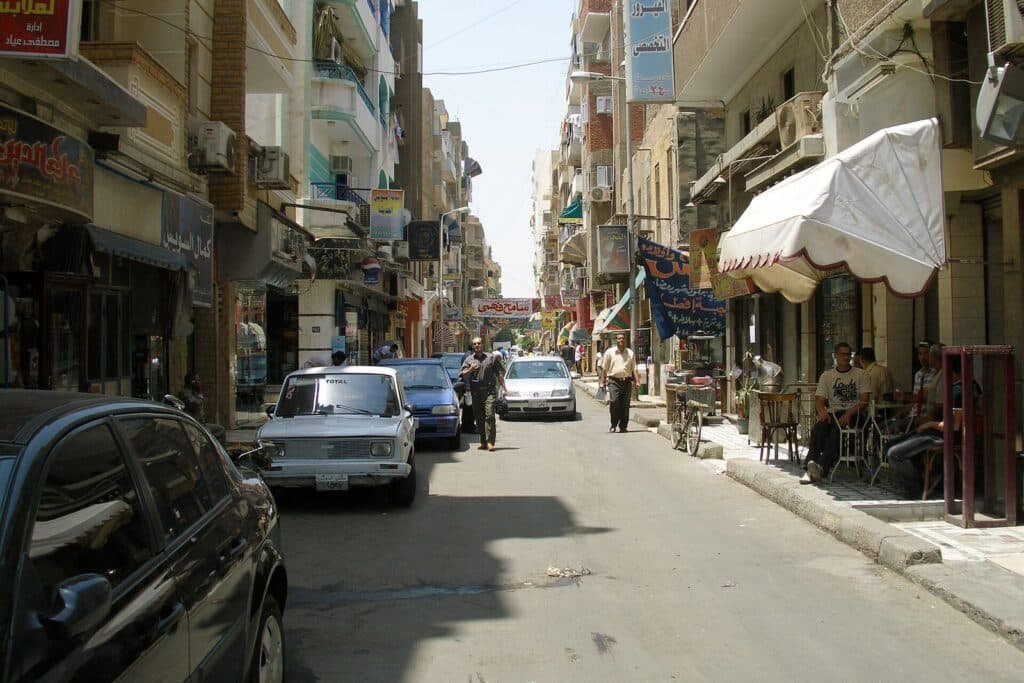
Illustrative photo: Port Said, Egypt, Street.jpg by Vyacheslav Argenberg / Wikimedia Commons. CC BY 4.0. Resized for display.
