Egypt is not a market most Asia-focused investors have placed at the top of their priority list. That calculus is shifting. A population of more than 110 million, a reform programme producing measurable fiscal results, a strategic position astride the Suez Canal, and GDP growth that the IMF projected to rise from 4.2% in 2026 to 4.8% in 2027 (IMF Middle East and Central Asia Regional Economic Outlook, April 2026) are collectively making Egypt a supply-chain, manufacturing and trade-route story with direct relevance to companies operating across Asia. This article maps the current state of Egypt’s economy, the trends driving it, the countries already paying attention, the sectors and companies in focus, and where the genuine commercial openings lie.
An Economy Under Pressure That Is Starting to Deliver Results
Egypt spent several years absorbing compounding shocks: high inflation, persistent foreign-currency pressure, a heavy debt load and regional instability that disrupted trade routes and investor confidence. Despite that, the headline indicators recorded in the financial year 2024/2025 were notably stronger than the period that preceded them.
Egypt recorded its highest-ever primary budget surplus in FY2024/2025 at 3.6% of GDP, according to reporting cited in the source material. Budget debt fell to 85.6% of GDP in June 2025, down from 89.4% a year earlier. Net foreign direct investment reached $9.3 billion in the first half of FY2025/2026, compared with roughly $6 billion in the same period the prior year. The Central Bank of Egypt recorded its highest-ever net foreign exchange reserves at $55.07 billion. These are government-reported and media-reported figures; independent verification of their methodology has not been supplied in the source documents.
The IMF’s growth trajectory — with momentum projected to extend through 2031 — places Egypt ahead of several regional peers at a moment when global growth is slowing. The scale argument is straightforward: Egypt is the Arab world’s most populous country, with approximately 60% of its population under the age of 30 (United Nations Population Fund Egypt data, as cited in the source).
Four Trends Reshaping Egypt’s Growth Model
The structural direction of Egypt’s economy is shifting in ways that matter to international capital. Four trends stand out from the supplied evidence.
From construction to export-led manufacturing. Egypt’s National Industrial Strategy sets a target of non-oil exports reaching $100 billion by 2030, with priority sectors identified as textiles, food processing, pharmaceuticals, automotive manufacturing, engineering, electrical equipment and electronics. The combination of a large labour force, port access and proximity to European and Gulf markets gives this target more foundation than many comparable national strategies.
Renewable energy at scale. The government has set a target of 42% of electricity generation from renewable sources by 2030, covering solar, wind and green hydrogen. The Benban Solar Park near Aswan, one of the world’s larger solar installations, illustrates the country’s capacity to deliver large infrastructure projects in this space.
Tourism recovery accelerating. Tourism grew by 17.3% in FY2024/2025 and is expected to continue rising, supported by the opening of the Grand Egyptian Museum and a revised national tourism strategy. Tourism brings foreign currency earnings and employment, both of which ease macroeconomic pressure.
A fast-growing technology sector. Egypt’s information, communications and technology sector has grown at 14–16% annually and now contributes approximately 6% of GDP, with digital exports reaching $7.4 billion. These figures are drawn from the World Economic Forum source article published October 2026 and represent the figures as reported there; they have not been independently verified in the supplied documents.
Which Countries Are Already Engaging
Egypt’s diplomatic weight gives it a broad engagement footprint. For Asia specifically, India is an active partner on the trade and investment side. Indian Prime Minister Narendra Modi and Egyptian President Abdel Fattah el-Sisi held bilateral talks in New Delhi in January 2023, agreeing to boost trade and investment ties, according to Nikkei Asia reporting at the time. The two countries’ shared concern about disruptions to food supply chains and commodity flows adds a practical dimension to the relationship beyond diplomacy.
China is not specifically detailed in the supplied source documents relative to Egypt investment, though the Suez Canal Economic Zone’s reported attraction of approximately $16 billion in investment over nearly four years suggests broad multinational participation that almost certainly includes Chinese industrial and logistics capital — though the source material does not break down this figure by country of origin.
Gulf states remain Egypt’s most proximate large investors and diplomatic allies, a relationship reinforced by Egypt’s role as a regional mediator. The World Economic Forum and the Government of Egypt are scheduled to convene a Country Strategy Meeting in Cairo in November 2026, bringing together global business and policy leaders to examine Egypt’s reform agenda and emerging opportunities — a signal that multilateral institutional interest is intensifying.
The Sectors and Economic Zones in Focus
The Suez Canal Economic Zone is the centrepiece of Egypt’s industrial and logistics pitch to foreign investors. Positioned around one of the world’s most consequential shipping routes — the Suez Canal carries an estimated 12–15% of global trade and around 30% of global container traffic — the zone is being developed as an integrated hub combining manufacturing, warehousing and port infrastructure.
Canal revenues dropped significantly during the Red Sea shipping disruptions tied to the regional conflict, before beginning to rebound. The disruption demonstrated Egypt’s leverage: when the route is impaired, global supply chains absorb higher costs and longer lead times. For companies reassessing supply-chain geography, Egypt’s position between Europe, the Gulf and sub-Saharan Africa is structurally valuable regardless of short-term route volatility.
A less-discussed but commercially significant layer is Egypt’s role as a digital transit point. The country carries an estimated 13% of global internet traffic and approximately 90% of international data transiting between Europe, Asia and Africa passes through Egyptian submarine cable infrastructure, according to analysis cited from the Centre for Strategic and International Studies Egypt case study (2025). This positions Egypt as a potential hub for data centres, artificial intelligence infrastructure and related technology investment.
Specific named companies investing in Egypt are not detailed in the supplied source material beyond the broad investment figures cited for the Suez Canal Economic Zone. Claims about individual company commitments should be verified against direct company disclosures or official registry filings before being used in investment decisions.
Where the Opportunities Are — and What Qualifies Them
For businesses with an Asia base looking outward, Egypt presents a set of layered opportunities that are distinct from the typical emerging-market entry story.
- Manufacturing and nearshoring: Egypt’s labour cost advantage, port access and proximity to European markets make it a credible production base for companies already weighing alternatives to purely Asia-based manufacturing. The priority export sectors — pharmaceuticals, textiles, automotive parts, electronics — overlap with industries where Asian firms already have strong operational expertise.
- Renewable energy and green industry: The government’s 42% renewables target by 2030, combined with Egypt’s solar and wind resource base, creates opportunities in project development, equipment supply and green hydrogen — sectors where Asian companies, particularly from China, South Korea and Japan, hold significant technological positions.
- Digital infrastructure: Egypt’s subsea cable centrality and a fast-growing domestic technology sector create demand for data centre capacity, cloud infrastructure and digital services. For Asian technology firms seeking a gateway between their home markets and Africa or Europe, Egypt’s connectivity position is a structural asset.
- Trade-route risk management: For Asian exporters and importers whose goods move through the Suez Canal, Egypt’s stability and the development of alternative logistics infrastructure in and around the canal zone are directly relevant to supply-chain continuity planning.
The reform agenda is the critical enabler for all of these. The government has stated priorities around faster permitting, simpler customs procedures and clearer competition rules. Progress on the business-environment side — translating fiscal stabilisation into operational ease — will determine whether the investment case moves from attractive to executable.
Outlook: Scale Plus Reform Momentum, With Execution the Key Variable
Goldman Sachs has projected, according to the World Economic Forum source article, that Egypt could rank among the world’s ten largest economies by 2075. Long-range projections of this kind carry wide uncertainty bands, but the underlying structural argument — scale, location, a young and growing workforce, and a reform trajectory — is not difficult to follow.
The more immediate question for business leaders is whether the fiscal improvements recorded in 2024 and 2025 translate into a noticeably better operating environment over the next two to three years. The primary surplus and foreign reserve milestones remove some of the macro risk that previously made investors cautious. The next phase — cleaner regulatory processes, more predictable contract enforcement, faster infrastructure permitting — will determine whether Egypt moves from a market worth monitoring to one worth committing capital to.
For Asia-based companies evaluating supply-chain geography, trade-route exposure, renewable energy expansion or digital infrastructure investment, Egypt in late 2026 sits at a point where the downside risks are more manageable than they were two years ago and the structural upside is unchanged. The November 2026 WEF Country Strategy Meeting in Cairo is the next public marker worth watching for signals on the pace and depth of the reform agenda’s next phase.
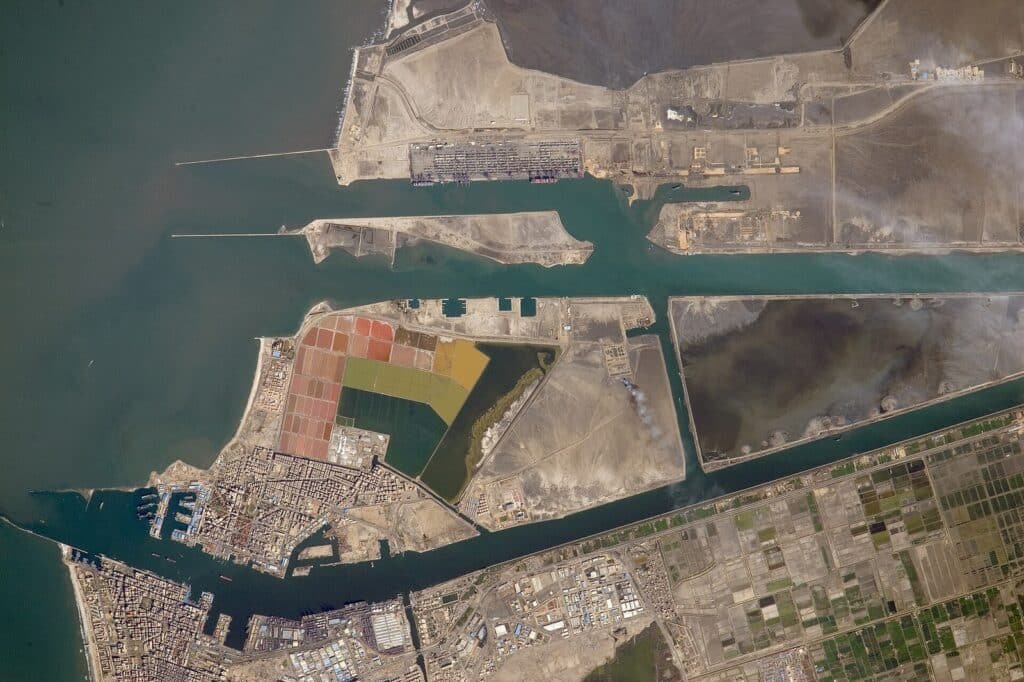
Illustrative photo: ISS-46 Suez Canal, Port Said, Egypt.jpg by NASA/Tim Kopra / Wikimedia Commons. Public domain. Resized for display.
